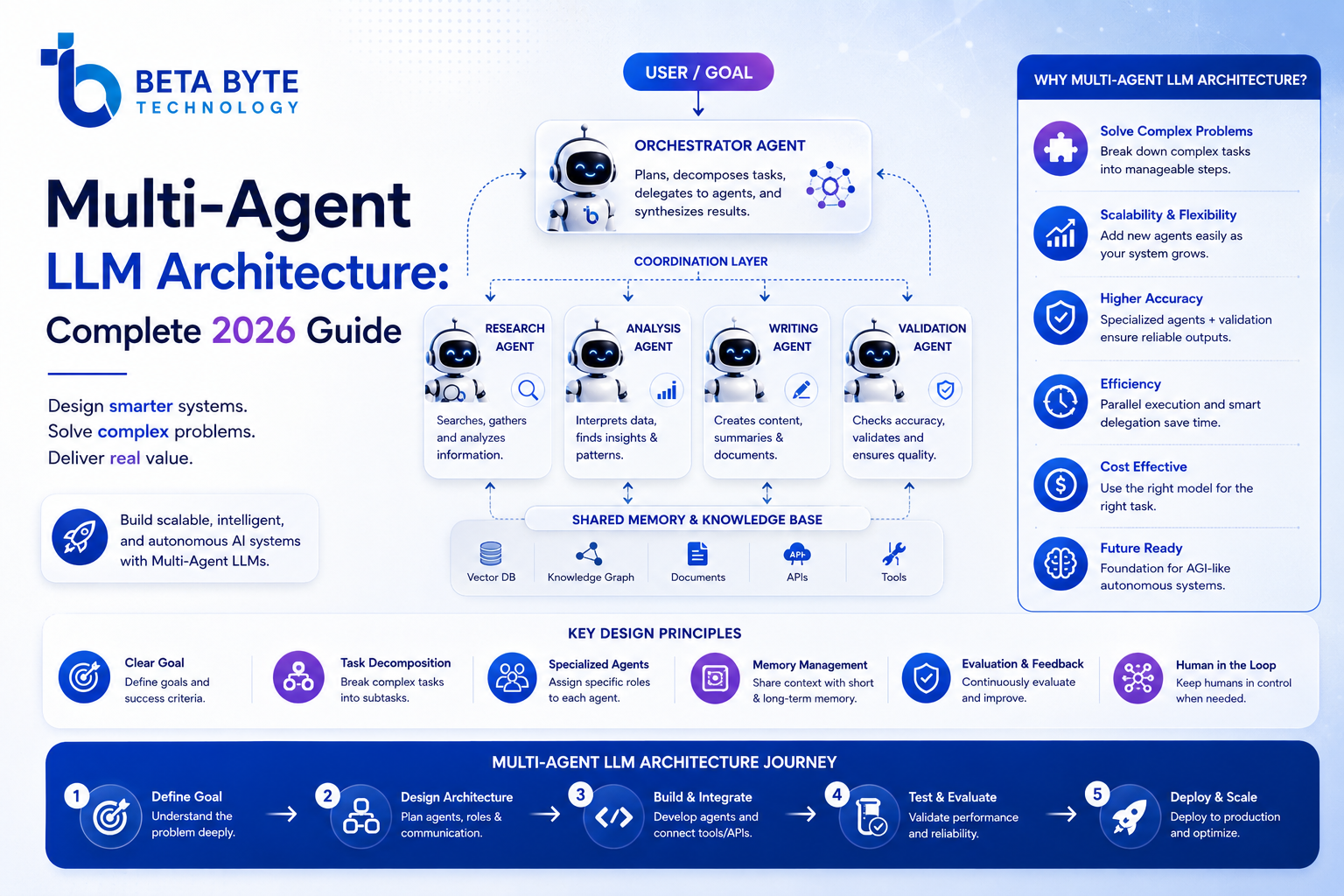
Multi-Agent LLM Architecture: How Autonomous AI Swarms Execute Complex Enterprise Tasks
Monolithic, single-prompt Large Language Model (LLM) workflows inevitably collapse when forced to execute complex, multi-step business operations. Tasking a single model instance with researching market trends, cross-referencing internal financial ledgers, drafting a compliance audit, and formatting an executive memo results in context drift, missed instructions, and catastrophic hallucinations. Single models lack the specialized cognitive boundaries, persistent state verification, and division of labor required for high-stakes enterprise processes.
Multi-agent workflow automation solves this bottleneck by breaking down complex operations into modular, specialized AI agents that collaborate, debate, and verify each other’s outputs within structured orchestration frameworks. Instead of relying on a single prompt to handle every variable, multi-agent architectures assign distinct personas—such as data extractors, analytical auditors, and quality controllers—that pass structured context across deterministic state graphs to execute end-to-end tasks with enterprise-grade reliability.
Transitioning from experimental single-prompt bots to scalable multi-agent swarms requires engineering leaders to understand coordination patterns, state management, and memory routing.
Key Architectural Takeaways for Tech Leaders
- Division of Cognitive Labor: Multi-agent systems divide complex tasks into isolated sub-problems, keeping context windows clean and dramatically lowering hallucination rates.
- Orchestration Topologies: Modern architectures utilize hierarchical (supervisor-worker) and sequential (assembly line) topologies built on graph-based state engines.
- Deterministic Verification: Dedicated critique and validation agents inspect outputs before database writes occur, preventing erroneous data propagation.
- Cost & Latency Optimization: Lightweight open-source models handle routing and data extraction, reserving expensive frontier models strictly for high-order reasoning.
- Production Engineering: BetaByte Technology constructs tailored multi-agent architectures that connect directly to legacy enterprise databases, custom APIs, and secure cloud environments.
What Is Multi-Agent LLM Architecture and Why Does Single-Prompt AI Fail at Scale?
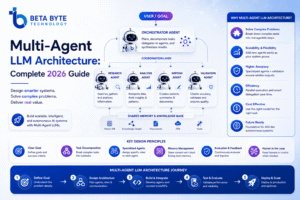
Multi-agent LLM architecture is a software design pattern where multiple autonomous AI agents—each with dedicated roles, tools, system instructions, and memory boundaries—collaborate within a shared environment to solve complex objectives. When a single LLM is fed a 50-step prompt packed with complex business rules, its attention mechanism experiences cognitive degradation, frequently prioritizing earlier or later tokens while ignoring intermediate constraints.
Multi-agent design treats artificial intelligence like a high-functioning human department. One agent acts as a specialized researcher gathering source materials, another acts as a domain specialist parsing technical implications, and a third acts as a compliance editor validating the final output against company policies.
According to enterprise engineering benchmarks in the Microsoft AutoGen Research Framework, multi-agent collaborative networks outperform single-agent prompting by over 35% in problem-solving accuracy on complex coding, financial analysis, and multi-system data synthesis benchmarks.
How Do Autonomous Agent Swarms Coordinate to Execute Complex Workflows?
Autonomous agent swarms coordinate through structured communication protocols, deterministic state graphs, and centralized memory buses that manage data handoffs between agents. Without disciplined orchestration rules, multi-agent systems can easily devolve into infinite conversational loops or uncontrolled token spending.
Production architectures engineered through custom AI software development rely on three foundational coordination patterns:
1. How Does Hierarchical Supervisor Orchestration Prevent Agent Drift?
Hierarchical orchestration utilizes a central supervisor agent to receive the high-level objective, decompose it into actionable sub-tasks, delegate those tasks to specialized worker agents, and evaluate the final compiled output. The supervisor acts as a project manager, maintaining the master project state and deciding which worker agent to activate based on the status of preceding steps.
- Task Decomposition: The supervisor breaks a broad mandate (e.g., “Perform competitor pricing analysis for Q3”) into distinct sub-tasks: scraping, currency normalization, and statistical modeling.
- Dynamic Delegation: Tasks are routed exclusively to worker agents equipped with the required toolsets (e.g., headless browsers, SQL connectors, Python code interpreters).
- Synthesis & Gatekeeping: The supervisor rejects substandard work from worker agents and triggers targeted rework loops before finalizing the result.
2. How Does Sequential Assembly Line Routing Streamline Structured Processes?
Sequential routing passes structured data artifacts linearly through a predetermined chain of specialized agents, where the validated output of Agent A becomes the direct input for Agent B. This pattern is ideal for deterministic operational pipelines such as invoice validation, contract analysis, and customer onboarding.
In a modern AI chatbot & workflow automation pipeline, a sequential chain processes inbound B2B contracts seamlessly:
- Extraction Agent: Converts raw PDF documents into clean, structured JSON schemas.
- Legal Auditing Agent: Scans extracted terms against standard company risk parameters and flags non-compliant indemnity clauses.
- Financial Alignment Agent: Verifies pricing schedules and payment terms against ERP database records.
- Notification Agent: Generates an executive summary and submits a human approval prompt to internal Slack or Teams channels.
3. How Does the “Critic-Actor” Verification Loop Eliminate Hallucinations?
The Critic-Actor loop pairs an action-oriented agent with an adversarial validator agent that checks every generated output against ground-truth data before execution. The actor agent drafts the code, writes the query, or generates the analytical report, while the critic agent evaluates the work against strict deterministic criteria, such as schema compliance, factual citation backing, and mathematical accuracy.
If the critic agent detects a logical flaw or an unsourced assertion, it provides actionable feedback back to the actor agent for immediate correction. This self-correcting feedback cycle ensures that only verified, hallucination-free data reaches production databases.
Single Monolithic LLMs vs. Multi-Agent Swarm Architectures
Understanding the structural differences between traditional prompting and multi-agent systems illustrates why forward-thinking CTOs are refactoring their AI software stacks.
| Architectural Dimension | Monolithic Single LLM Prompt | Multi-Agent Swarm System (BetaByte Tech) |
| Cognitive Scope | Broad, overloaded context window | Narrow, role-specific system prompts |
| Hallucination Risk | High on multi-step, complex workflows | Minimal due to inter-agent critic verification |
| Tool Integration | Single model struggles with 10+ tool schemas | Isolated agents carry 1–3 specific tools |
| Context Degradation | Rapid loss of instruction adherence | Ephemeral, clean context per sub-task |
| Debugging & Observability | Black box; difficult to identify failure point | Granular trace logging per agent execution step |
| Cost Efficiency | Expensive frontier model used for all steps | Model cascading (SLMs for routing, LLMs for logic) |
| Error Recovery | Hard system failure upon unexpected output | Dynamic retry, tool re-selection, and fallback routing |
What Infrastructure Is Required to Deploy Multi-Agent Systems in Production?
Deploying multi-agent systems in production requires a robust state management layer, persistent vector memory, rate-limiting middleware, and comprehensive observability tracing. Moving beyond academic prototypes requires enterprise-grade engineering that ensures predictability, security, and low operational latency.
ENTERPRISE MULTI-AGENT RUNTIME ARCHITECTURE
---------------------------------------------------------------------------------
[API Gateway / Webhooks] ──> [Supervisor Orchestration Engine (LangGraph)]
                                          │
                  ┌───────────────────────┼───────────────────────┐
                  ▼                       ▼                       ▼
          [Data Worker Agent]   [Analytical Agent]      [Critic/Audit Agent]
          • SQL / REST APIs     • Python Code Exec      • Pydantic Validators
          • Web Scrapers        • Embedding Vectors     • Schema Enforcement
                  │                       │                       │
                  └───────────────────────┼───────────────────────┘
                                          ▼
                  [Unified Memory Bus (Redis State + Vector DB)]
                                          │
                                          ▼
         [Deterministic Enterprise Action / Database Commit / Human Approval]
---------------------------------------------------------------------------------
State Management & Graph Frameworks
Production agents should not be built on unbounded loops. Modern architectures utilize directed acyclic graphs (DAGs) and cyclic state machines via frameworks like LangGraph and AutoGen. These frameworks maintain strict state persistence, allowing workflows to pause for human approval, recover from transient network errors, and resume without losing context.
Memory Tiering: Ephemeral vs. Persistent Vector Stores
Multi-agent swarms require two distinct memory layers:
- Short-Term Working Memory: High-speed, in-memory state stores (such as Redis) that hold active variables, agent conversation states, and intermediate JSON objects during an active workflow run.
- Long-Term Episodic Memory: Vector databases (such as Qdrant, Pinecone, or pgvector) that store historical interaction logs, company knowledge bases, and resolved operational cases for semantic retrieval.
For enterprises operating customer-facing portals built with custom WordPress engineering, integrating unified vector memory enables multi-agent swarms to reference past user interactions instantly while maintaining zero-latency page speeds.
Model Cascading and Cost Management
Routing every agent transaction to top-tier frontier models like GPT-4o or Claude 3.5 Sonnet results in unsustainably high API bills. BetaByte Technology engineers cost-optimized model cascading pipelines:
- Fast, cost-effective models (e.g., Llama 3 8B, GPT-4o-mini) handle routing, data extraction, and formatting tasks.
- High-reasoning frontier models are invoked strictly for complex logic, multi-variable synthesis, and final supervisory decisions.
- Semantic caching layers intercept duplicate requests, eliminating unnecessary LLM inference costs entirely.
For deeper technical specifications on agent tool routing and API parameters, consult the OpenAI Platform Documentation
FAQ’s:
How do you prevent multi-agent swarms from entering infinite conversation loops?
Infinite loops are prevented by enforcing strict graph recursion limits, deterministic exit conditions, and step-budget counters in the orchestration framework. If an agent pair exceeds a predefined number of critique-revision cycles without reaching consensus, the state engine automatically pauses execution and alerts a human operator.
What is the difference between LangGraph, AutoGen, and CrewAI for multi-agent development?
LangGraph excels at deterministic, graph-based control flows with fine-grained state management; AutoGen specializes in dynamic, conversational multi-agent problem-solving; and CrewAI focuses on role-playing, persona-driven workflows. Enterprise applications typically rely on LangGraph due to its strict schema adherence, cyclic graph support, and production debugging tools.
Are multi-agent systems slower than traditional single-prompt AI workflows?
Multi-agent workflows can introduce higher initial latency due to sequential reasoning and verification steps, but they deliver drastically higher task completion accuracy. For latency-sensitive applications, architectures execute independent sub-tasks in parallel and utilize lightweight, fine-tuned models to achieve near-instantaneous execution.
How do multi-agent systems maintain enterprise data privacy and security?
Enterprise multi-agent systems maintain security by running within dedicated private cloud VPCs, enforcing Role-Based Access Controls (RBAC) per agent, and ensuring strict zero-data-retention compliance. Individual agents are granted least-privilege API keys, ensuring an analytics agent cannot access sensitive payment tables or write unauthorized database changes.
Build Scalable Multi-Agent Automation with BetaByte Technology
Relying on brittle single-prompt scripts limits what artificial intelligence can achieve across your business operations. Unlocking true operational scalability requires robust, production-grade multi-agent architectures that execute complex, multi-system workflows with precision and resilience.
At BetaByte Technology, our team of senior software architects, AI engineers, and workflow automation specialists builds bespoke multi-agent platforms, custom RAG pipelines, and enterprise software systems designed to solve your most demanding operational bottlenecks.
Ready to architect an autonomous multi-agent system for your business?
Book a Technical Architecture Consultation with BetaByte Technology Today