Custom AI Software Development Cost: The Honest 2026 Pricing Breakdown
Budgeting for artificial intelligence software is notoriously difficult for business leaders. Vendor estimates swing wildly from $5,000 offshore freelance builds to $250,000 enterprise consulting contracts, often with zero transparency around recurring token usage, infrastructure hosting, or data engineering requirements. Many executives commit to projects without understanding whether they are paying for a superficial API wrapper or a resilient, production-grade software architecture.
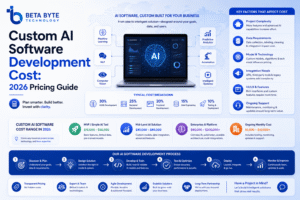
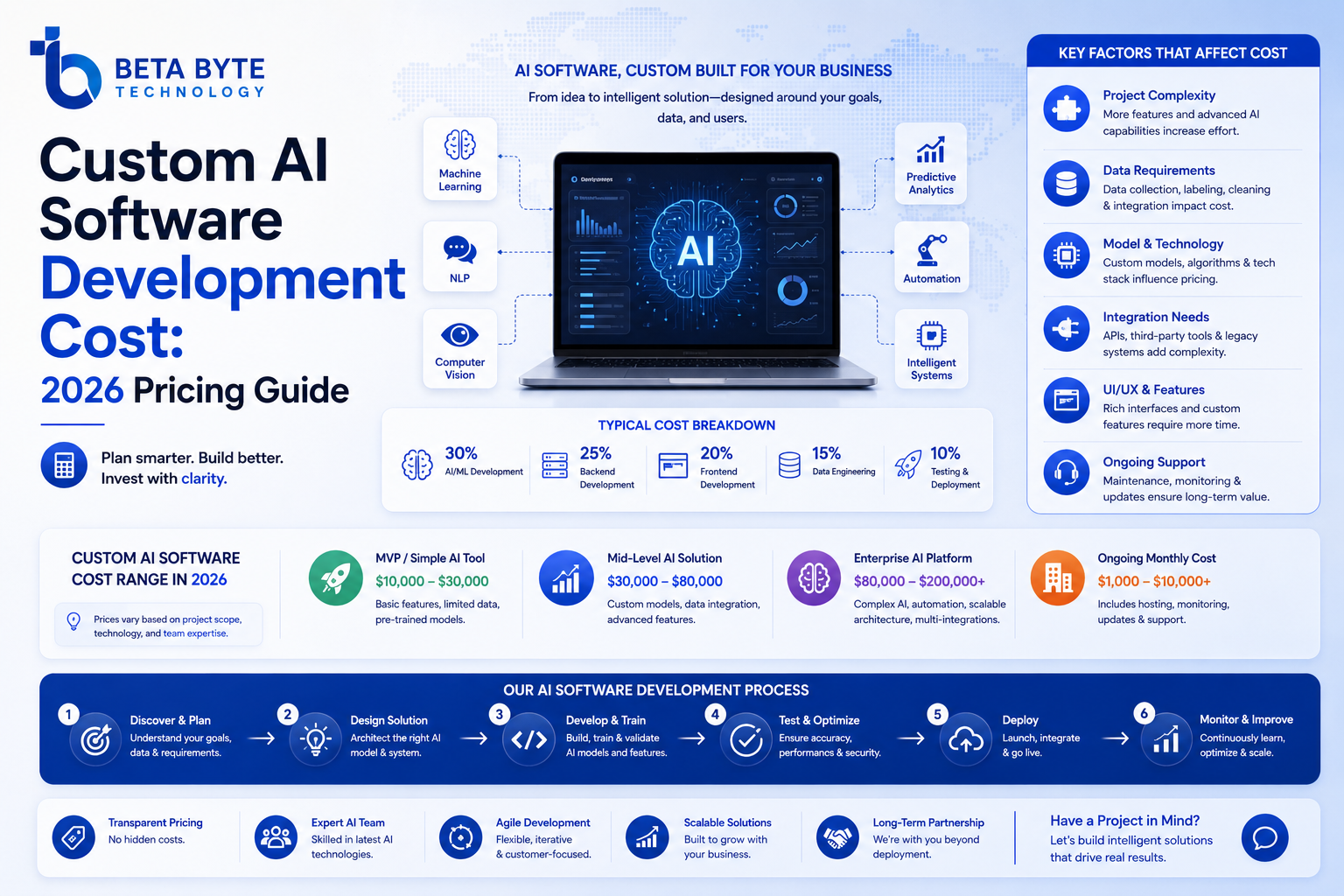
In 2026, the custom AI software development cost for a production-ready application typically ranges between $15,000 and $85,000, depending on data complexity, system integrations, and agent autonomy levels. While lightweight AI Minimum Viable Products (MVPs) start around $10,000 to $20,000, enterprise-grade multi-agent platforms and private RAG architectures requiring custom API middleware typically fall in the $35,000 to $70,000 range.
To plan a predictable AI software budget, CTOs and product founders must examine the core cost tiers, architectural drivers, and recurring operational expenditures that dictate the true Total Cost of Ownership (TCO).
Executive Cost & ROI Summary
- Entry-Level MVPs ($10k–$20k): Focused on single-workflow validation, prompt-engineered pipelines, and standard cloud database integrations within 4 to 8 weeks.
- Production Enterprise RAG ($20k–$45k): Multi-source internal knowledge bases with private vector search, semantic caching, and role-based permissions.
- Autonomous Multi-Agent Platforms ($35k–$75k+): Self-healing, state-driven agent networks with bi-directional CRM, ERP, and payment API integrations.
- SaaS Replacement ROI: Replacing seat-based third-party AI subscriptions with an owned internal tool typically delivers full capital payback within 5 to 9 months.
- Engineering Delivery: BetaByte Technology builds fixed-scope, production-grade AI applications that eliminate runaway token bills and third-party vendor lock-in.
How Much Does Custom AI Software Development Cost Across Different Complexity Tiers?
The cost of custom AI software correlates directly with the number of integrated external systems, the structure of your underlying proprietary data, and the level of autonomous decision-making required by the application. Simple applications that query a single foundational model via standard APIs require far less engineering time than distributed multi-agent systems that write directly to enterprise databases.
| Development Scope & Architecture Tier | Typical Cost Range (USD) | Standard Delivery Timeline | Typical Business Deliverable |
| Tier 1: AI Prototype / Rapid MVP | $10,000 – $20,000 | 4 to 8 Weeks | Core feature validation, single-model integration, clean Next.js/React UI, basic authentication. |
| Tier 2: Enterprise RAG & Knowledge Hubs | $20,000 – $45,000 | 8 to 12 Weeks | Multi-format document parsing (PDF/DOCX), vector database indexing, private cloud security, zero-retention compliance. |
| Tier 3: Autonomous Workflow & Multi-Agent Swarms | $35,000 – $75,000 | 10 to 16 Weeks | Complex multi-step task execution, LangGraph state persistence, auto-healing schema validation, bi-directional CRM/ERP writes. |
| Tier 4: Fine-Tuned Foundation Models & Custom Platforms | $60,000 – $150,000+ | 16 to 24+ Weeks | Custom parameter fine-tuning (LoRA/QLoRA), private GPU cluster deployment (AWS/RunPod), full-stack multi-tenant SaaS architecture. |
According to industry economic data from the Gartner IT Spending and Software Engineering Benchmarks, custom software initiatives that replace recurring third-party seat licenses generate an average 34% lower 3-year operating cost compared to enterprise SaaS subscriptions.
What Key Technical Factors Drive the Price of Custom AI Development?
1. How Does Data Hygiene and Vector Database Architecture Impact Engineering Hours?
Data hygiene and vector architecture represent 30% to 40% of total project costs because AI models cannot generate reliable outputs from disorganized or corrupted source data. If an organization’s internal documentation exists as unstructured scanned PDFs, outdated spreadsheets, and siloed intranet wikis, engineers must build custom extraction, cleaning, and chunking pipelines before any AI logic can function.
Engineering an enterprise Retrieval-Augmented Generation (RAG) system via custom AI software development requires:
- Building automated OCR pipelines to parse complex tables, diagrams, and multi-column documents.
- Selecting and configuring vector databases (such as Qdrant, Pinecone, or pgvector) for low-latency semantic search.
- Designing hybrid retrieval algorithms (combining keyword search with dense vector embeddings) to ensure sub-second query retrieval.
2. How Does Integration with Legacy Enterprise CRMs and ERPs Affect the Budget?
Integrating AI with legacy enterprise software increases development costs due to the necessity of building custom API adapters, defensive middleware, and state-recovery engines. Connecting an AI agent to a modern REST API with comprehensive documentation is straightforward; bridging an autonomous model with an on-premise SAP instance, older SQL databases, or legacy SOAP webhooks requires dedicated backend engineering.
To ensure transactional safety, BetaByte Tech implements:
- Deterministic Schema Guards: Pydantic validation layers that intercept and reformat malformed model outputs before they touch production databases.
- Asynchronous Message Queues: Decoupled event brokers (such as RabbitMQ or AWS SQS) that meter high-volume AI requests and prevent downstream ERP rate-limit crashes.
- Human-in-the-Loop Safeguards: Dedicated approval triggers that require human managerial sign-off for financial transactions or contract modifications.
3. What Are the Real UI/UX and Frontend Engineering Costs for AI Applications?
Frontend engineering for AI applications costs between $5,000 and $18,000 because generative interfaces require real-time streaming connections, optimistic UI updates, and interactive canvas components. Static form-based dashboards are insufficient for modern AI tools; users expect streaming token responses, inline citation highlights, and real-time document editing sidebars.
Whether delivering a standalone web portal in Next.js or integrating generative search widgets into marketing sites engineered with custom WordPress engineering, full-stack engineers must implement WebSockets or Server-Sent Events (SSE) to handle streaming states without UI freezing.
What Are the Recurring Operational Costs of Running AI Software in 2026?
The ongoing cost of running custom AI software typically ranges from $150 to $1,500 per month for small-to-midsize deployments, driven primarily by foundation model API tokens, cloud compute, and vector database hosting. Unlike traditional software where hosting scales predictably with bandwidth, AI operational expenditures are influenced heavily by token consumption and inference frequency.
MONTHLY AI INFRASTRUCTURE BREAKDOWN (MID-SIZE ENTERPRISE USAGE)
-------------------------------------------------------------------------------
• Foundation Model APIs (Token Routing + Cascading):    $120 – $600 / month
• Cloud Hosting & Serverless Compute (AWS / GCP):       $80 – $250 / month
• Managed Vector Database (Qdrant / Pinecone / pgvector): $50 – $200 / month
• Semantic Cache & State Store (Managed Redis):         $30 – $100 / month
• Telemetry, Tracing & Observability (Langfuse / Datadog): $0 – $150 / month
-------------------------------------------------------------------------------
ESTIMATED TOTAL MONTHLY RUNTIME:                        $280 – $1,300 / month
To prevent runaway token bills, modern software architectures incorporate semantic prompt caching and model cascading. Basic classification and data routing tasks are offloaded to fast, cost-effective models (such as GPT-4o-mini or Llama 3 8B), reserving premium models exclusively for multi-step logical reasoning.
For real-time token pricing and rate limit benchmarks, reference the official OpenAI Pricing Documentation.
Build vs. Buy: Why Custom AI Delivers Higher Long-Term ROI Than SaaS
Building custom AI software delivers superior financial ROI over third-party SaaS subscriptions once your team exceeds 15 to 20 active users or requires proprietary workflow customization. Enterprise AI SaaS platforms frequently charge $40 to $120 per user per month, plus expensive add-on fees for custom data indexing and API access.
THE 2-YEAR TOTAL COST OF OWNERSHIP (TCO) COMPARISON
-------------------------------------------------------------------------------
Scenario: 35-Person Operations Team Automating Document & Customer Workflows

OFF-THE-SHELF ENTERPRISE SAAS:
• 35 Seats @ $90/user/month:                    $37,800 / year
• Enterprise API & Data Add-on Fees:            $12,000 / year
• 2-Year Total Outlay:                          $99,600 (Zero Asset Ownership)

CUSTOM BETABYTE TECH AI BUILD:
• Initial Custom Engineering & Deployment:       $32,000 (One-Time CapEx)
• Monthly Infrastructure & API Tokens (~$400/mo): $9,600 (Over 2 Years)
• Maintenance & Quarterly Feature Upgrades:     $8,000 (Over 2 Years)
• 2-Year Total Outlay:                          $49,600 (100% Owned IP)
-------------------------------------------------------------------------------
NET 2-YEAR SAVINGS WITH CUSTOM BUILD:           $50,000+
Beyond direct software savings, custom-built platforms deployed within an AI chatbot & workflow automation ecosystem ensure complete data sovereignty, eliminate third-party vendor lock-in, and adapt precisely to your operational workflows.
Frequently Asked Questions About Custom AI Development Costs
Why do custom AI development quotes vary so dramatically between agencies?
Quotes vary because different agencies quote fundamentally different architectural scopes. Lower quotes ($5,000–$10,000) typically involve basic no-code wrappers or generic API calls with no data engineering or security guardrails. Higher quotes ($30,000–$70,000+) reflect production-grade software engineering, including custom RAG pipelines, defensive middleware, automated testing, and dedicated database integrations.
How much does it cost to fine-tune an open-source Large Language Model?
Fine-tuning an open-source model (such as Llama 3 or Mistral) typically costs between $8,000 and $25,000 for data preparation, synthetic dataset generation, LoRA training runs, and private cloud deployment. However, 85% of business use cases do not require fine-tuning and achieve superior accuracy at lower cost using optimized RAG pipelines.
How can a startup or enterprise keep initial AI development costs down?
Organizations keep costs down by launching with a focused, single-workflow MVP rather than attempting to automate an entire department at once. Limiting initial scope to a high-friction bottleneck, implementing semantic prompt caching, and using pre-built open-source orchestration modules significantly lowers upfront development hours.
Does building custom AI software mean we are locked into a specific model vendor?
No, custom-engineered software architectures utilize model-agnostic orchestration layers that allow you to switch providers with a single configuration update. If a new foundation model offers lower pricing or superior speed, your application routes traffic dynamically without requiring code refactoring.
Plan Your AI Software Roadmap with BetaByte Technology
Navigating the costs of custom artificial intelligence development requires an engineering partner that prioritizes commercial ROI, transparent software architecture, and disciplined resource management. Rushing into bloated enterprise contracts or fragile low-code prototypes wastes valuable capital and delays your time-to-market.
At BetaByte Technology, our software architects and AI engineers work directly with CTOs, founders, and enterprise operators to scope, design, and deploy high-performing AI applications with clear milestones and fixed-scope pricing models.
Ready to get a precise, transparent engineering estimate for your AI project in 2026?
Book a Technical Discovery Consultation with BetaByte Technology Today