AI Agents vs Zapier: When Does Your Business Outgrow Basic No-Code Automation?
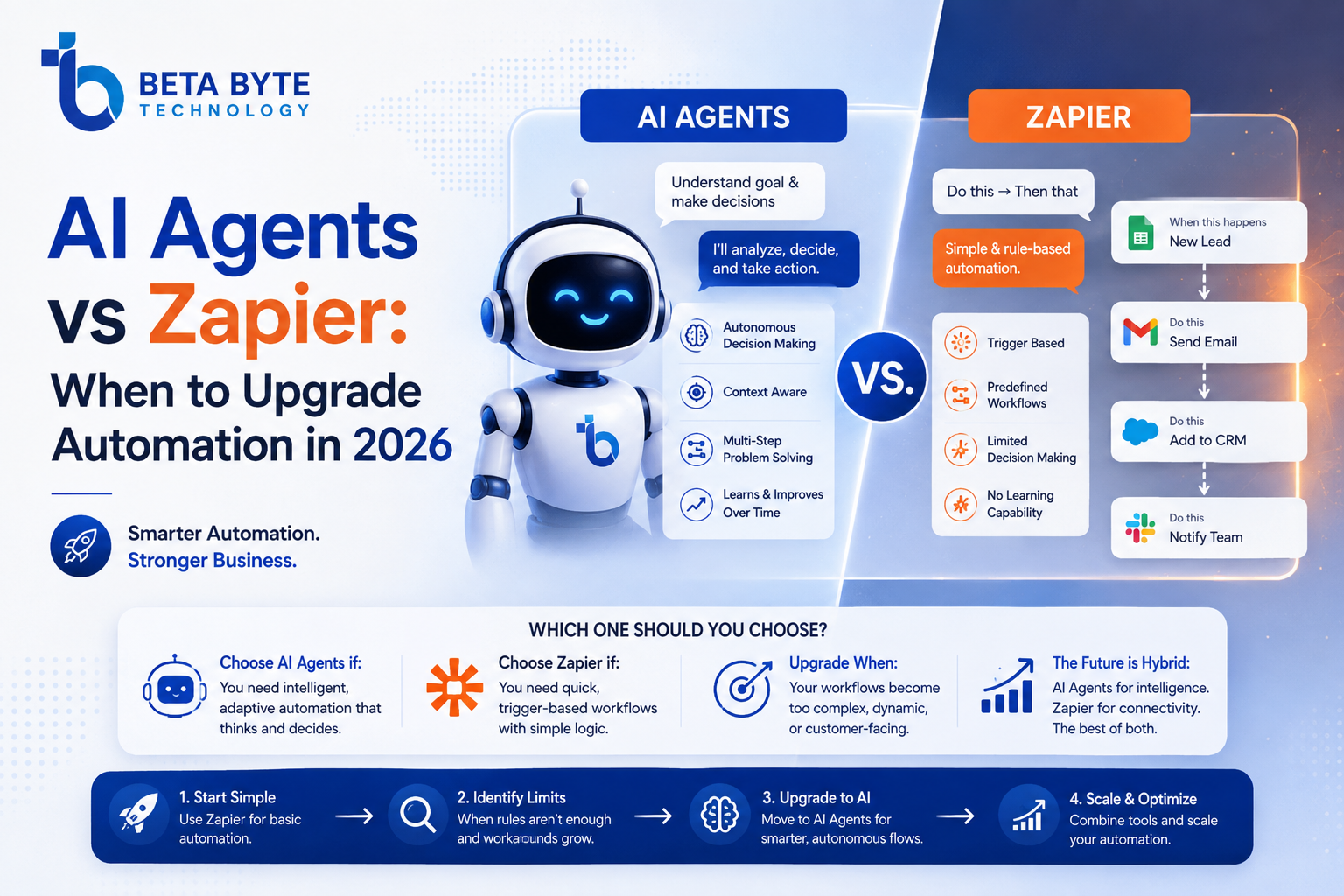
AI Agents vs Zapier? What does you business needs? Businesses outgrow no-code tools like Zapier and Make when their workflows require contextual decision-making, dynamic error handling, multi-system reasoning, or processing high transaction volumes where per-task pricing becomes prohibitively expensive.
Upgrading to custom-engineered AI agents replaces brittle, linear “if-this-then-that” triggers with goal-oriented, autonomous reasoning loops that execute complex multi-step tasks directly across private databases and enterprise APIs.
Every growing organization eventually hits the “No-Code Wall.” What started as a clean, 3-step Zapier workflow connecting a lead form to a CRM gradually morphs into a fragile web of 40-step zaps, complex nested filters, custom JavaScript snippets, and constant webhook timeouts. When an unexpected edge case occurs or an API payload structure changes, the entire pipeline quietly breaks, leaving operations teams to manually clean up corrupted records.
While no-code tools remain effective for simple point-to-point data synchronization, scaling modern operations requires an understanding of where no-code automation fails and how custom AI architectures solve those bottlenecks.
What Is the Core Difference Between AI Agents and No-Code Automation Tools Like Zapier and Make?
The fundamental difference is that Zapier and Make execute rigid, deterministic scripts step-by-step, whereas AI agents operate through autonomous reasoning loops that adapt their actions based on real-time context. A traditional no-code workflow follows a predetermined path: if Step A happens, execute Step B, then Step C. If Step B encounters an unexpected input or an API timeout, the workflow fails.
In contrast, an autonomous AI agent is assigned an objective (e.g., “Reconcile vendor invoices against purchase orders and resolve discrepancies with the vendor via email”). The agent dynamically selects which tools to call, queries internal databases, evaluates unstructured responses, and handles edge cases autonomously without requiring a pre-mapped branch for every potential scenario.
| Operational Dimension | No-Code Automation (Zapier / Make) | Custom Autonomous AI Agents (BetaByte Tech) |
| Execution Model | Linear, deterministic triggers | Goal-driven, adaptive reasoning loops |
| Logic & Decision Handling | Static boolean conditions and nested filters | Contextual LLM evaluation and dynamic tool calling |
| Data Adaptability | Breaks on unexpected or unstructured inputs | Parses unstructured documents, PDFs, and conversational data |
| Error Recovery | Hard failure; requires human intervention | Self-correcting retries, fallback routing, and alert logging |
| State & Memory | Stateless per execution (limited cross-step context) | Persistent short-term and long-term vector memory |
| Cost Scaling Model | Linear task-based fees (expensive at volume) | Fixed cloud compute and token-optimized API calls |
| Integration Depth | Constrained by third-party app directory limitations | Native bi-directional REST, GraphQL, and direct SQL access |
According to technical benchmarks in the LangChain Architectural Documentation, multi-agent frameworks reduce workflow failure rates in complex data-processing pipelines by over 40% compared to rigid, multi-nested conditional pipelines.
What Are the Clear Signs Your Business Has Outgrown Zapier and Make?
When Do Complex Branching Logics and Brittle Webhooks Cause System Failures?
You have outgrown no-code tools when your automation requires dozens of nested routers, conditional paths, and regex scripts just to handle common edge cases. No-code platforms are designed for straightforward data passing. As soon as your operational workflow demands conditional loops, variable evaluation, or real-time fallback paths, visual builders become unmaintainable spaghetti architectures.
A minor schema change from a vendor API or an unexpected null value in a webhook payload often halts an entire no-code scenario. Debugging these issues across multiple 30-step workflows wastes valuable engineering and operational hours. Transitioning to custom AI software development allows your team to deploy resilient Python or Node.js microservices with comprehensive error logging, unit testing, and graceful fallback mechanisms.
Why Does Task-Based Pricing on Make and Zapier Erode Profit Margins at Scale?
Task-based pricing structures penalize operational growth by charging escalating monthly fees for every individual step executed in a workflow. If an e-commerce brand or logistics firm processes 50,000 transactions a month, and each transaction requires a 10-step no-code scenario (lookup, filter, update CRM, create invoice, send notification, log audit), that single process consumes 500,000 tasks every month.
SCENARIO: Processing 500,000 Monthly Automation Steps:


• Enterprise No-Code Platform: $800 – $1,800/month (recurring seat & task fees)

• Custom AWS/Serverless Agent:  $65 – $150/month (raw compute & token routing)

------------------------------------------------------
Annual Operational Cost Difference: Up to $19,800 saved per workflow.
By shifting high-volume workflows to dedicated microservices engineered by BetaByte Technology, enterprises replace perpetual third-party task taxes with predictable, cost-optimized cloud infrastructure.
How Do Context Windows and Long-Term Memory Expose No-Code AI Limitations?
No-code AI steps treat each action in isolation, lacking the persistent memory and deep context retrieval needed for sophisticated business decisions.
While platforms like Zapier now offer basic OpenAI integration blocks, they typically operate in single-prompt silos. They cannot maintain contextual history across multiple departments, cross-reference historical database records, or query private vector stores without cumbersome workarounds.
Enterprise-grade automation requires continuous context. An autonomous agent deployed within an AI chatbot & workflow automation ecosystem accesses shared vector embeddings, historical user interaction logs, and relational databases simultaneously, allowing it to make nuanced decisions that reflect your company’s operational history.
How Do Custom AI Agents Handle Enterprise Edge Cases and Dynamic Workflows?
Custom AI agents resolve edge cases through autonomous tool selection, structured output validation, and continuous self-reflection loops. When an agent encounters an anomaly—such as a missing customer tax ID or an ambiguous invoice line item—it does not simply throw a fatal error. Instead, it systematically investigates alternative data sources, queries supplementary APIs, or drafts a targeted clarification request to a human manager.
BetaByte Tech builds custom agentic pipelines using advanced frameworks like LangGraph and AutoGen, incorporating:
- Deterministic Guardrails: Strict schema enforcement (via Pydantic and JSON schema validation) ensures the agent never passes malformed data to your production databases.
- Semantic Verification: Before any critical database write or financial transaction executes, secondary validator agents review the output to prevent hallucinations.
- Human-in-the-Loop Interventions: High-stakes decisions (e.g., approving refunds over a specific dollar threshold) automatically pause execution and prompt human managers via Slack or email for one-click approval.
How Should Companies Transition from No-Code Workflows to Custom AI Agents?
The most effective migration strategy is a hybrid transition: keep simple, low-volume point-to-point syncs on no-code platforms while refactoring core, high-volume, and logic-intensive pipelines into custom AI microservices. Attempting to rebuild every minor office trigger at once is inefficient; engineering resources should focus exclusively on the workflows that directly impact customer experience, revenue velocity, and operating margins.
MIGRATION MATRIX FOR OPERATIONS LEADERS:
| Keep on Zapier / Make: | Migrate to Custom AI Agents: |
| New blog post -> Tweet | Inbound lead qualification & enrichment |
| Simple form -> Google Shee | Automated invoice & contract processing |
| Low-volume calendar alerts | Multi-system customer onboarding flows |
| Internal Slack notifications | Dynamic inventory & supplier negotiations |
By connecting custom microservices to your front-facing platforms—including web portals built with custom WordPress engineering your business establishes a reliable, scalable foundation that grows without technical friction.
Frequently Asked Questions About AI Agents vs No-Code Automation
Can no-code tools like Zapier and Make run true autonomous AI agents?
No, while Zapier and Make offer AI prompt modules, they execute those modules within a rigid, sequential structure rather than true autonomous agency. True AI agents require dynamic loops, recursive tool selection, vector retrieval, and persistent state management, which visual no-code builders cannot execute at scale.
Is building a custom AI agent significantly more expensive than paying for Zapier?
Building a custom AI agent requires an initial engineering investment, but it yields a dramatically lower total cost of ownership (TCO) at scale. For high-volume workflows, eliminating monthly per-task SaaS fees and reducing manual human error typically results in full capital payback within 3 to 6 months.
How do custom AI agents connect to legacy enterprise software?
Custom AI agents connect directly via REST APIs, GraphQL, webhooks, or direct database connectors (PostgreSQL, MySQL, MongoDB). For legacy systems lacking modern APIs, engineering teams build secure middleware adapters that bridge legacy databases with modern AI orchestration layers.
What happens if an AI agent hallucinates or makes a mistake during execution?
Production-grade AI agent architectures prevent hallucinations through deterministic schema validation, automated self-reflection checks, and human-in-the-loop escalation triggers. If an agent’s confidence score falls below a set threshold on critical tasks, the system automatically routes the case to a human operator for review.
Upgrade Your Business Automation Beyond No-Code Limits with BetaByte Technology
Relying on brittle no-code workflows to run critical business processes introduces operational vulnerabilities, inflated subscription fees, and scalability limits. Moving to enterprise-grade operations requires custom-engineered software designed to handle real-world business complexity.
At BetaByte Technology, our software architects and AI engineers build custom multi-agent systems, intelligent workflow engines, and scalable full-stack applications tailored to your exact business logic. We eliminate the limitations of no-code platforms and build resilient automation that scales with your growth.
Ready to replace brittle zaps with production-grade AI agents in 2026? Book a Technical Automation Consultation with BetaByte Technology Today