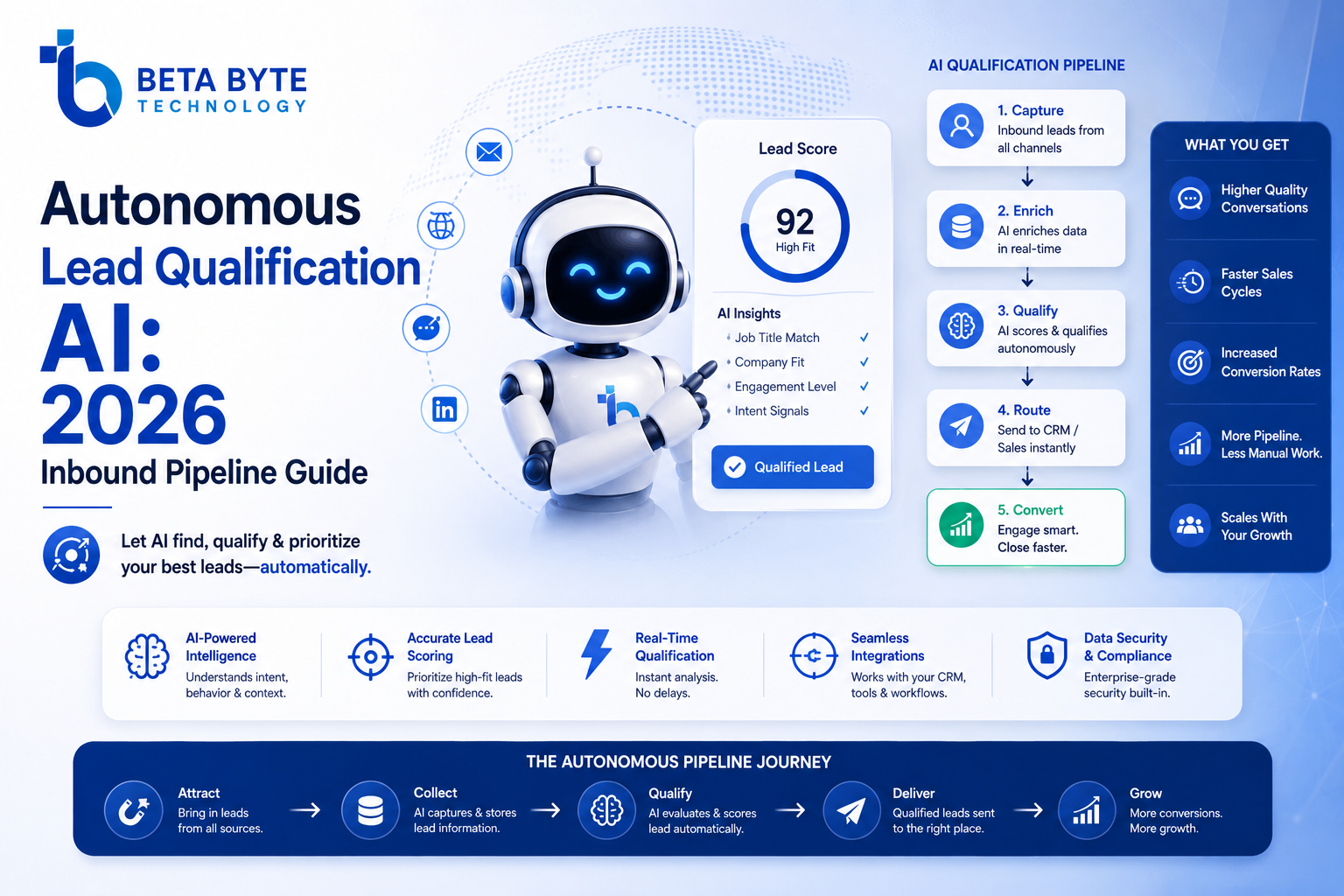
Autonomous Lead Qualification AI: How to Build a High-Converting Inbound Pipeline in 2026
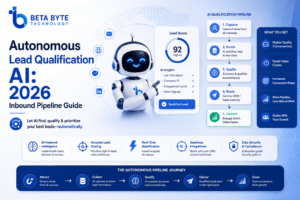
An autonomous lead qualification AI pipeline eliminates manual SDR friction by instantly capturing inbound submissions, enriching firmographic data via live web scrapers and APIs, evaluating Ideal Customer Profile (ICP) fit using Large Language Models, and routing qualified opportunities to sales calendars within 60 seconds. By engineering an autonomous qualification engine directly into your revenue stack, your organization reduces response times to near-zero, cuts customer acquisition costs, and lets Account Executives focus exclusively on closing qualified revenue.
B2B sales teams lose high-value deals before having a single conversation. In modern B2B buying cycles, prospective clients evaluate multiple vendors simultaneously and expect immediate technical clarity. When an inbound inquiry sits in a general CRM inbox for hours—or days—waiting for a human Sales Development Representative (SDR) to manually research the prospect, check company size, verify budget alignment, and send a calendar link, deal momentum drops off significantly.
To build an inbound pipeline that scales predictably, revenue and engineering leaders must transition away from static forms and slow triage queues toward agent-driven revenue infrastructure.
Key Architectural Insights for Revenue Leaders
- Speed-to-Lead Primacy: Inbound buyers are up to 21 times more likely to enter the sales pipeline when contacted within five minutes compared to 30 minutes.
- Automated Enrichment: Custom AI agents aggregate LinkedIn profiles, company revenues, tech stacks, and recent press releases in under 10 seconds.
- Contextual ICP Scoring: Semantic evaluation models analyze nuanced inquiry descriptions, identifying genuine buying intent that generic form drop-downs miss.
- Zero-Friction Routing: High-fit prospects receive instant booking links mapped dynamically to AE availability, while low-fit leads enter automated nurture sequences.
- Custom Infrastructure: BetaByte Technology builds bespoke lead qualification pipelines that connect directly to your custom web applications, HubSpot, or Salesforce environments.
Why Does Traditional Inbound Lead Qualification Fail in Modern B2B Environments?
Traditional lead qualification fails because manual human triage creates response delays, introduces human bias, and burns expensive SDR hours on low-intent inquiries. When prospects fill out standard contact forms, human reps typically spend 15 to 20 minutes across LinkedIn, Crunchbase, and company websites just to verify if the account meets core revenue or employee thresholds. During this research delay, prospective clients continue researching competing vendors who respond faster.
According to research from the HubSpot State of Sales Report, sales teams that implement real-time inbound automation experience a 28% higher close rate on inbound deals, driven almost entirely by eliminating initial contact latency.
Furthermore, traditional multi-field forms create high friction on front-facing sites. Asking buyers to fill out 12 required fields lowers form conversion rates drastically. An autonomous pipeline solves this by allowing you to keep public forms concise—such as simple name, email, and project scope inputs—while AI agents handle the data enrichment in the background.
What Are the Core Architectural Layers of an Autonomous AI Qualification Pipeline?
Building an enterprise-grade qualification engine requires connecting ingestion webhooks, enrichment agents, LLM evaluation logic, and CRM orchestration into a continuous event-driven workflow.
How Does Real-Time Data Enrichment Uncover Firmographic Context?
Real-time enrichment operates through background AI microservices that pull public and private database records the moment an email address or domain is submitted. Instead of relying solely on the data the prospect typed into a contact form, the pipeline triggers targeted API lookups and agentic web scrapers to assemble a comprehensive account dossier in seconds.
When a lead enters the system, the enrichment layer gathers:
- Company Size & Revenue: Current headcount, estimated annual turnover, and recent funding rounds.
- Technology Stack Identification: Live DNS lookups and script analyzers that detect whether the prospect uses specific platforms (e.g., Salesforce, AWS, Shopify, custom Next.js apps).
- Key Stakeholder Roles: Verification of the prospect’s exact job title, department, and decision-making authority.
- Recent Business Triggers: Hiring surges, leadership changes, or new product launches that signal immediate project urgency.
Integrating this background enrichment via custom AI software development ensures that your sales team receives an enriched profile before the first discovery call even starts.
How Does Intent Scoring and Semantic Analysis Evaluate Buying Signals?
Semantic analysis uses fine-tuned LLM evaluators to read open-ended project descriptions and score commercial intent based on operational urgency, technical requirements, and budget indicators. Traditional lead scoring relies on arbitrary numeric point systems (e.g., +5 points for downloading an eBook), which often creates false positives and wastes AE calendar slots.
RAW LEAD SUBMISSION

"We're looking to automate our multi-vendor invoice parsing workflow and connect it directly to our NetSuite database. Need this live by Q3."

AUTONOMOUS INTENT EVALUATION

• Primary Objective: Intelligent Document Processing / ERP Integration

• Urgency Level: High (Clear timeline constraint: Q3)

• Technical Complexity: Enterprise (NetSuite API / Custom DB)

• ICP Match Score: 94/100 (Tier-1 Qualified)
The AI scoring engine compares the natural language submission against your exact ICP criteria. It flags clear indicators—such as specific technical blockers, clear timelines, and explicit scope requirements—while filtering out job seekers, academic inquiries, and spam.
How Does Automated Calendar Routing and CRM Sync Accelerate Pipeline Velocity?
Automated routing moves qualified prospects straight from form submission to a booked sales call while updating CRM records and notifying account executives via Slack or Microsoft Teams. If the AI engine confirms a high ICP score, the prospect is redirected instantly to an embedded calendar pre-filtered to the correct AE based on industry vertical, deal size, or geographic territory.
Deploying a custom AI chatbot & workflow automationarchitecture ensures that:
- CRM Records Are Instantly Populated: HubSpot or Salesforce deals are created with custom property fields, conversation transcripts, and enrichment metrics.
- Pre-Call Briefs Are Generated: The AE receives a 3-bullet briefing doc summarizing the client’s core pain points, estimated budget band, and recommended pitch strategy.
- Low-Fit Leads Are Diverted Gracefully: Prospects who do not meet tier-1 criteria are routed to automated email nurture sequences, resource hubs, or self-service demos without consuming sales reps’ time.
Traditional Manual SDR Qualification vs. Autonomous BetaByte Tech AI Pipeline
Comparing manual human qualification against a dedicated AI automation engine highlights why high-growth B2B firms are refactoring their sales tech stacks.
| Evaluation Metric | Traditional SDR Qualification | Autonomous BetaByte Tech AI Pipeline |
| Initial Response Time | 4 to 24 Hours | < 60 Seconds (Real-Time) |
| Enrichment Depth | Manual, inconsistent research | Standardized API & Web Scraped Dossier |
| Lead Form Friction | 10–15 required fields (Low conversion) | 2–4 essential fields (High conversion) |
| Scoring Consistency | Subjective, prone to rep fatigue | Deterministic ICP rules + Semantic LLM evaluation |
| Calendar Booking Rate | 20–35% of qualified leads | 55–70% instant conversion via edge redirects |
| Cost per Qualified Lead | High (Salary, commissions, SaaS seats) | Low (Predictable cloud & API infrastructure) |
| Operational Scaling | Requires hiring additional SDRs | Handles 10x lead spikes with zero extra headcount |
How Does BetaByte Technology Deploy an Autonomous Inbound Pipeline?
Building a reliable inbound qualification system requires deep integration with your existing marketing channels and internal databases. BetaByte Technology engineers custom lead qualification engines tailored to your exact tech stack through a four-phase development lifecycle:
Phase 1: Ingestion Gateway & Webhook Architecture
We configure secure API endpoints and event-driven webhooks that capture form submissions from custom web applications, landing pages, or marketing sites engineered with [Internal Link: “custom WordPress engineering” -> https://betabytetech.com/].
Phase 2: Agentic Multi-Source Enrichment Engine
Our team builds custom Python and Node.js microservices that query multiple data providers, company registries, and live web domains in parallel, generating a structured JSON account profile in milliseconds.
Phase 3: Deterministic Guardrails & Intent Evaluation
We deploy prompt-engineered LLM models wrapped in strict Pydantic validation layers. This guarantees that model evaluation outputs strictly match predefined scoring schemas, preventing hallucinations and erratic lead classifications.
Phase 4: Bi-Directional CRM & Notification Sync
We integrate the AI agent directly into your sales infrastructure—updating custom CRM objects, assigning account owners, generating automated executive summaries, and dispatching real-time alerts to your sales channels.
Frequently Asked Questions:
How does the AI determine if an inbound lead meets our Ideal Customer Profile (ICP)?
The AI evaluates ICP fit by combining deterministic data filters with semantic language evaluation. Deterministic checks confirm measurable firmographics like employee count, revenue, and industry classification, while the LLM assesses project descriptions, scope complexity, and timeline urgency to calculate an overall fit score.
Will automated qualification feel cold or robotic to high-value enterprise prospects?
No, automated qualification enhances the prospect experience by removing friction and delivering immediate value. Qualified buyers do not experience generic automated back-and-forth emails; instead, they receive instant booking access with the right technical expert along with personalized confirmation notes that reference their specific requirements.
Can the qualification agent connect with custom proprietary CRMs or databases?
Yes, custom AI qualification pipelines can connect to any platform that exposes a REST or GraphQL API, as well as direct SQL/NoSQL databases. Unlike rigid off-the-shelf SaaS tools limited to pre-built app directories, custom engineering allows direct integration with proprietary backends, legacy databases, and custom enterprise portals.
What happens when an inbound lead provides invalid or incomplete information?
When a lead submits incomplete or disposable email addresses, the AI engine uses domain resolution and fallback verification tools to cross-reference the sender. If an account cannot be verified, the pipeline flags the record, routes it to a secondary email verification loop, or assigns a lower initial score without polluting your primary sales queue.
Build a Scalable Inbound Revenue Engine with BetaByte Technology
Slow response times and manual sales triage should not bottleneck your company’s revenue growth. Transitioning to an autonomous lead qualification architecture ensures that every high-intent prospect receives immediate attention, your sales reps walk into every discovery call prepared, and your operational overhead remains low.
At BetaByte Technology, our AI architects and full-stack software engineers design production-grade automation systems, custom LLM integrations, and robust web applications that accelerate business performance.
Ready to deploy an autonomous lead qualification pipeline for your sales team?
Book a Technical Strategy Consultation with BetaByte Technology Today