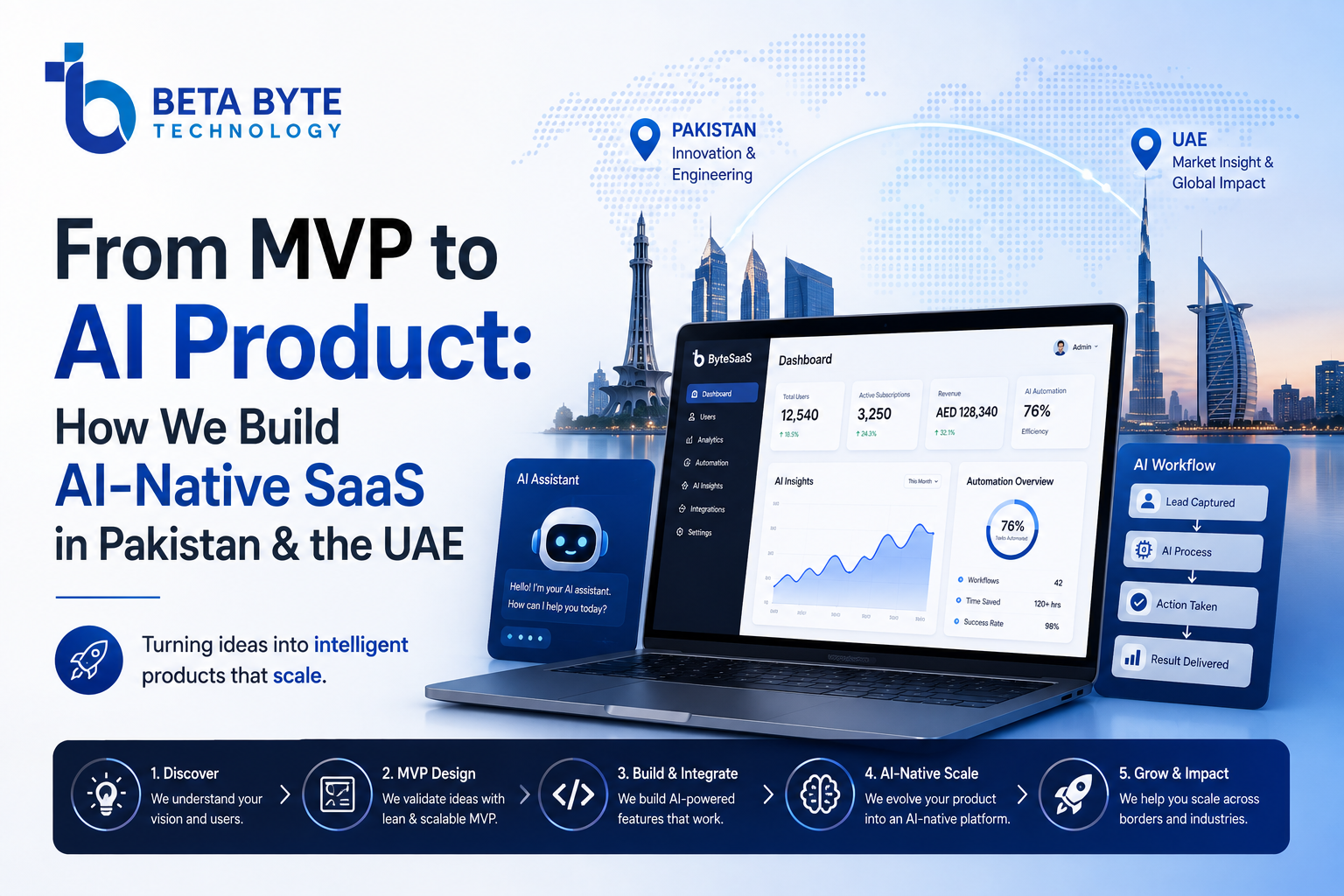
From MVP to AI Product: How We Build AI-Native SaaS in Pakistan & the UAE in 2026
To build AI-native SaaS products efficiently, founders leverage the tech corridor between Pakistan and the UAE, combining Pakistan’s deep software engineering talent with the UAE’s enterprise market and capital ecosystem. By partnering with an agile engineering team like BetaByte Technology, founders can launch a production-ready AI SaaS Minimum Viable Product (MVP) in 8 to 12 weeks, cutting initial development expenditures by up to 60% without compromising on architecture scalability or data security.
Early-stage software founders face a dual challenge in 2026: building cutting-edge, AI-native SaaS products quickly enough to secure market share while managing the high development burn rates and token usage costs typical of generative AI infrastructure. Navigating this challenge requires a development model that balances technical precision with strategic cost efficiency across fast-growing venture hubs like Dubai, Abu Dhabi, and Riyadh.
Successfully launching an AI product requires moving beyond simple wrapper applications to build resilient, multi-tenant software architectures designed for long-term growth.
KEY TAKEAWAYS FOR SAAS FOUNDERS:
•Regional Tech Corridor: Combining Pakistan’s engineering talent with
UAE capital creates a capital-efficient launchpad for AI SaaS.
• Architecture Pivot: AI-native SaaS relies on dynamic RAG pipelines
and vector databases rather than static CRUD operations.
• Speed-to-Market: Modular microservices allow BetaByte Tech to ship
production MVPs in 8 to 12 weeks.
• Cost Optimization: Semantic prompt caching and model cascading
reduce LLM inference overhead by up to 65%.
• Enterprise Delivery: BetaByte Tech builds secure, multi-tenant AI
platforms tailored for MENA and global market expansion.
Why Are Pakistan and the UAE Becoming the Global Epicenter for AI-Native SaaS Development?
Combining Pakistan’s deep software engineering talent pool with the UAE’s thriving capital, enterprise market demand, and progressive AI governance creates a high-velocity development corridor for AI-native SaaS startups.
While the UAE serves as the commercial hub, regulatory sandbox, and primary enterprise sales market, engineering hubs in Pakistan provide the technical horsepower required to architect complex Large Language Model (LLM) pipelines, vector search platforms, and cloud microservices.
According to economic indicators from the UAE National Strategy for Artificial Intelligence 2031, the region aims to boost its digital economy by integrating AI across all priority sectors. This initiative drives enterprise demand for custom B2B software solutions.
How Does the Pakistan-UAE Tech Corridor Lower Development Capital Requirements?
The Pakistan-UAE tech corridor slashes early-stage SaaS development costs by 50% to 70% while maintaining Silicon Valley-grade code quality and rapid sprint execution.
For seed-stage founders and enterprise innovation labs based in the GCC, outsourcing core platform engineering to specialized full-stack teams in Pakistan extends financial runway significantly.
Collaborating with BetaByte Technology enables founders to:
- Reallocate saved capital toward customer acquisition, regional sales, and compliance licensing in the UAE.
- Work across aligned time zones, enabling real-time communication between business stakeholders in Dubai and engineering teams.
- Utilize custom AI software development frameworks to launch software faster than traditional in-house hiring allows.
How Do AI-Native SaaS Architectures Differ from Traditional SaaS?
AI-native SaaS architecture centers around an orchestration layer that dynamically routes queries between vector databases, fine-tuned foundational LLMs, and multi-tenant backend APIs.
Unlike traditional SaaS platforms that execute static Database CRUD (Create, Read, Update, Delete) operations, AI-native platforms manage non-deterministic outputs, real-time context retrieval, and continuous model feedback loops.
| Architectural Layer | Traditional SaaS Stack | Modern AI-Native SaaS Stack |
| Data Storage Layer | Relational SQL / NoSQL (PostgreSQL, MongoDB) | Hybrid Vector Databases (Pinecone, Qdrant, Milvus) + SQL |
| Business Logic Layer | Static Application Code (Node.js, Django) | Dynamic Orchestration (LangChain, LlamaIndex, vLLM) |
| Query Processing | Exact Pattern Match & Database Indexing | Semantic Search & Contextual Embeddings |
| Compute Overhead | CPU-Dominant Application Hosting | GPU Inference + Model API Orchestration |
| UI/UX Interaction | Static Forms, Dashboards, & Inputs | Generative Interfaces, Streaming Text, & Canvas UI |
What Is BetaByte Tech’s 4-Step Engineering Process for AI SaaS MVPs?
BetaByte Tech’s engineering process transitions concepts from initial prototype to production-grade SaaS in 8 to 12 weeks through rapid architecture scoping, modular RAG integration, microservice deployment, and edge UI/UX engineering. This structured pipeline eliminates technical debt while ensuring the application scales smoothly as active user concurrency grows.
BETABYTE TECH AI SAAS MVP FRAMEWORK:
STEP 1: Product Architecture & Tech Stack Scoping
(Database schema, multi-tenancy rules, security specs)
│
STEP 2: Retrieval-Augmented Generation (RAG) & Vector Setup
(Data chunking, vector embeddings, semantic search routing)
│
STEP 3: Multi-Tenant Backend & Microservice Development
(Authentication, role-based access, API gateway, billing)
│
STEP 4: Streaming UI/UX & Continuous Integration (CI/CD)
(React/Next.js frontend, prompt caching, deployment)
Step 1: Product Architecture & Tech Stack Scoping
Engineers map out tenant isolation rules, database schemas, and external API dependencies. Choosing the right foundational frameworks—such as Python, FastAPI, React/Next.js, and PostgreSQL—ensures the backend handles heavy asynchronous workloads.
Step 2: Retrieval-Augmented Generation (RAG) & Vector Setup
To ensure responses remain grounded and accurate, we engineer a enterprise-grade RAG pipeline. Using documentation parsing libraries and high-dimensional vector databases, the SaaS indexes proprietary data securely for contextual retrieval. Reference technical specs via the OpenAI API Documentation.
Step 3: Multi-Tenant Backend & Microservice Development
Security is critical when serving enterprise accounts in the GCC region. We implement strict data segregation, Role-Based Access Controls (RBAC), Stripe/Paddle payment gateway integrations, and API rate limiters to protect platform infrastructure.
Step 4: Streaming UI/UX & Continuous Integration (CI/CD)
To eliminate latency friction, frontend interfaces utilize real-time WebSocket streaming, optimistic UI updates, and responsive dashboard controls. Combining custom WordPress engineering for front-facing marketing sites with Next.js web portals ensures high organic SEO alongside web app performance.
How Do SaaS Founders Control LLM Token Costs and API Latency?
Founders control LLM token costs and API latency by implementing semantic prompt caching, model cascading, and hybrid open-source LLM hosting. Uncontrolled API calls to foundation models like GPT-4o or Claude 3.5 Sonnet can erode profit margins if every user query triggers a full model inference run.
MODEL CASCADING & ROUTING FLOW
User Query -> Semantic Cache Hit? -> [Yes] -> Return Instant Result ($0)
│
No
│
Low Complexity Query? —-> [Yes] -> Fast Open Source / Fine-Tuned Model
│
No
│
High Complexity Query —> Send to Frontier LLM (GPT-4o / Claude)
To optimize unit economics, BetaByte Technology implements three core architectural safeguards:
- Semantic Prompt Caching: Systems like Redis or GPTCache store previous query-response pairs. If a new query matches a previous context semantically, the answer returns instantly without API usage costs.
- Model Cascading: Simple routing rules direct basic user tasks to lighter open-source models (e.g., Llama 3 8B, Mistral), reserving expensive frontier LLMs strictly for complex logical reasoning.
- Fine-Tuned Open-Source Hosting: Deploying quantized, fine-tuned open-source models on dedicated cloud GPU instances (AWS, RunPod) caps monthly operational expenses as user volume scales.
Integrating these optimizations into AI chatbot & workflow automation systems reduces LLM inference costs by up to 65%.
FAQ’s Section:
Why build an AI-native SaaS in Pakistan and launch in the UAE?
Building in Pakistan while launching in the UAE pairs high-tier software engineering efficiency with one of the world’s fastest-growing enterprise tech markets. Founders lower initial development expenditure while maintaining direct access to GCC venture capital, business incentives, and high-value corporate clients.
What is the typical timeline to build an AI-native SaaS MVP?
The typical timeline to build a production-grade AI-native SaaS MVP is 8 to 12 weeks. This timeline includes technical architecture design, RAG database implementation, multi-tenant security development, billing integration, and frontend user testing.
How much does it cost to build an AI-native SaaS product from scratch?
Building a custom AI-native SaaS MVP typically costs between $15,000 and $50,000+, depending on system complexity, model integration needs, and enterprise compliance requirements. Partnering with a specialized software firm like BetaByte Tech offers a cost structure lower than equivalent development in Western tech hubs.
How do you handle data privacy and sovereignty regulations in the GCC region?
Data privacy and sovereignty in the GCC are managed by deploying cloud infrastructure within regional data centers (such as AWS Middle East or UAE Azure regions) and enforcing strict end-to-end data encryption. System architectures ensure proprietary customer data is never sent to public LLMs or used for external model training.
Launch Your AI-Native SaaS with BetaByte Technology
Transitioning an AI product from initial concept to a scalable, revenue-generating SaaS application requires disciplined software engineering, cost-effective infrastructure design, and an understanding of target markets.
At BetaByte Technology, our software architects and AI developers partner with founders in Pakistan, the UAE, and worldwide to construct high-performing AI products. From RAG architecture design to full-stack web applications, we provide the technical expertise needed to scale your platform efficiently.
Ready to build your AI-native SaaS platform in 2026? Book a Technical Strategy Consultation with BetaByte Technology Today