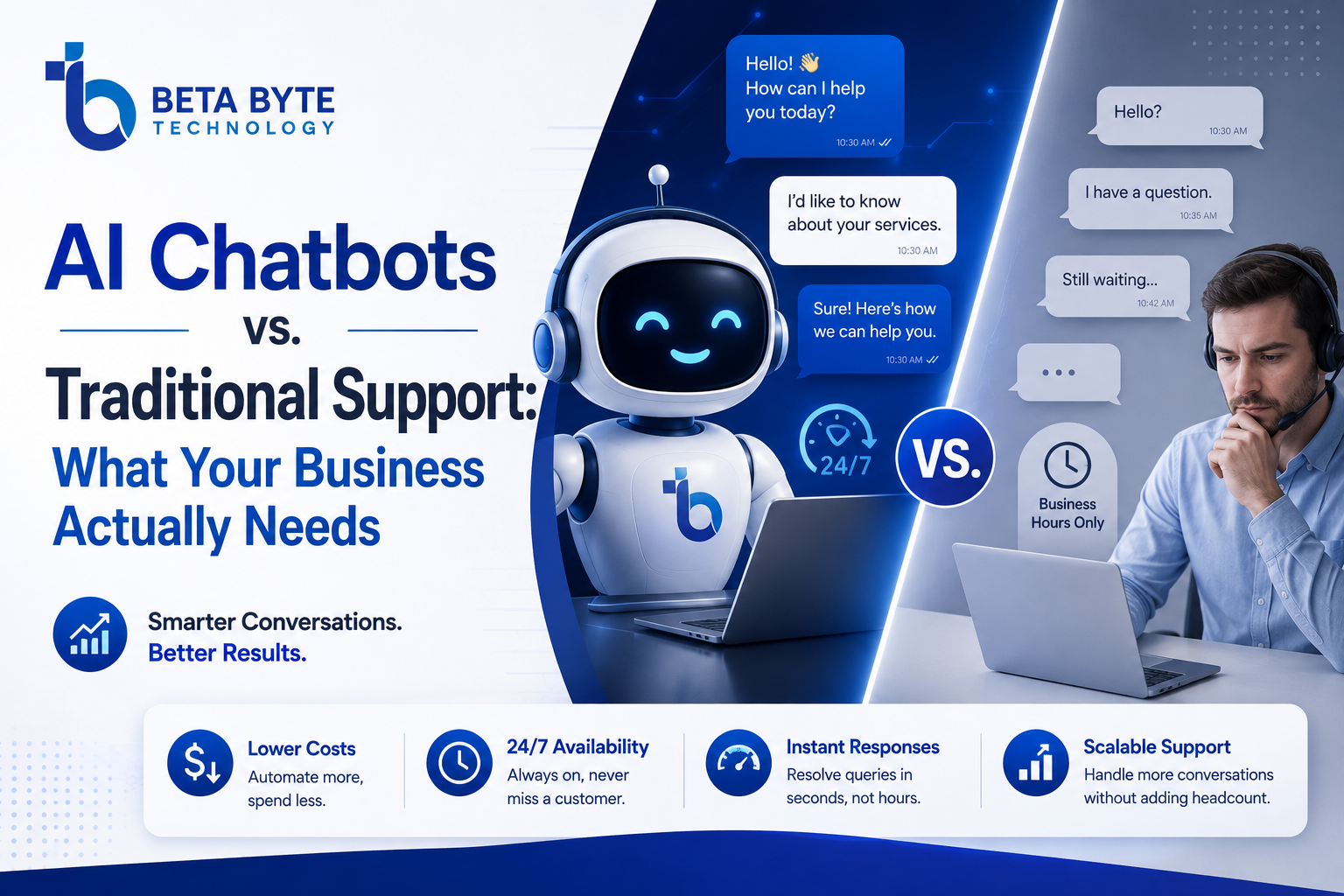
AI Chatbots vs Traditional Support: What Your Business Actually Needs in 2026
Scaling customer operations in 2026 presents a difficult dilemma: relying strictly on human support teams creates unsustainable labor costs and slow response times, while deploying generic, off-the-shelf chatbots frustrates customers with dead-end answers. Modern buyers demand sub-minute response times without sacrificing the nuanced resolution that only human empathy provides.
In 2026, high-performing enterprises do not choose between AI chatbots or traditional support—they deploy a hybrid AI support model that combines autonomous tier-1 deflection with human agent escalation. By building custom RAG-powered conversational AI agents that resolve 55% to 70% of routine inquiries and automatically hand off complex tickets with full conversation context, organizations lower cost-per-contact by up to 40% while raising overall Customer Satisfaction (CSAT) scores.
To build a resilient support stack, engineering and CX leaders must evaluate the technical limits of full automation and design system architectures that optimize both speed and human connection.
KEY TAKEAWAYS FOR CX & TECH LEADS:
• Tier-1 Deflection Realities: Production AI reliably automates 55-70%
of routine queries; vendor claims of 90%+ total replacement fail.
• Contextual Escalation: Custom AI agents summarize interaction logs to
cut human agent Average Handle Time (AHT) by 35-45%.
• Consumer Preferences: 79% of users prefer human access for complex
disputes, making seamless hybrid routing essential for retention.
• Data Quality Priority: 62% of failed AI support deployments stem from
disorganized knowledge bases rather than model flaws.
• Enterprise Delivery: BetaByte Tech builds tailored, API-integrated
support engines that connect directly with backend ERP and CRM data.
What Is the Real Difference Between AI Chatbots and Traditional Support in 2026?
The fundamental difference lies in operational elasticity: traditional support provides high-empathy, complex problem-solving at fixed labor capacity, whereas modern AI chatbots offer instant, zero-marginal-cost scaling for routine technical and transactional queries. Traditional support relies on human agents handling one or two tickets simultaneously, creating long queue times during operational spikes. Conversely, generative AI agents query backend APIs instantly to execute real-time status updates, returns, and account modifications across thousands of concurrent sessions.
According to the Zendesk CX Trends Report organizations deploying context-aware tier-1 deflection achieve up to an 18% CSAT increase within 90 days, driven primarily by drastic reductions in initial response times.
Architectural Comparison: Traditional Human Support vs. Rule-Based Bots vs. Custom AI Agents
Deploying traditional support alone results in high labor overhead, while rigid rule-based bots alienate users with fixed decision trees. Modern generative AI agents overcome both limitations by utilizing custom Large Language Model (LLM) architectures and vector retrieval systems to parse user intent dynamically.
| Capabilities & Performance | Traditional Human Support | Legacy Rule-Based Bots | Custom BetaByte Tech AI Agents |
| Average First Response Time | 15–45 Minutes | < 5 Seconds | < 2 Seconds |
| Tier-1 Ticket Resolution | 100% (High Cost) | 15–20% (Rigid Scripts) | 55–70% (Fully Autonomous) |
| Escalation Context Transfer | Manual Notes / Disjointed | Lost / Re-asked | Automated Context Summarization |
| Scaling Capacity | Linear (Requires Hiring) | Infinite (Low Quality) | Infinite (High Precision) |
| Cost per Resolved Ticket | $6.00 – $15.00 | $0.20 – $0.50 | $0.40 – $1.10 |
| Database & API Execution | Manual GUI Lookup | No Native Execution | Bi-Directional API Read/Write |
Why Is a Hybrid Support Model Better Than Full AI Automation?
1. How Does Tier-1 AI Deflection Protect Human Agent Capacity?
Tier-1 AI deflection protects human capacity by offloading repetitive transactional tasks—such as order tracking, appointment scheduling, and basic password resets—directly to autonomous bots. When human agents are freed from answering the same 10 to 15 routine questions daily, they can dedicate their time to high-value account management, escalation troubleshooting, and customer retention strategies.
Integrating tailored AI chatbot & workflow automation into your existing helpdesk ecosystem ensures that:
- Transactional Volume Is Automated: Autonomous agents query warehouse management systems (WMS) to report exact shipping status in real time.
- Support Queues Are Flattened: Peak holiday or promotional spikes are absorbed without emergency hiring or overtime expenses.
- Agent Burnout Is Reduced: Support teams experience lower turnover rates when repetitive, mind-numbing ticketing queues are eliminated.
2. Why Do Consumers Demand a Seamless Human Escalation Option?
Consumers demand a human escalation option because complex billing disputes, emotional complaints, and unique system edge cases require human judgment, policy flexibility, and empathy. Research from industry benchmarks shows that over 79% of consumers strongly prefer human interaction when resolving complex or sensitive account issues.
When an AI chatbot reaches its confidence limit or detects rising customer frustration through sentiment analysis, it must trigger a soft handoff. By leveraging custom middleware built through custom AI software development, the system compiles a complete transcript summary and metadata payload, enabling the human agent to jump into the chat without asking the customer to repeat themselves.
3. How Does Context Summarization Cut Average Handling Time (AHT)?
Context summarization cuts Average Handling Time by using natural language processing to condense lengthy chatbot interactions into concise, actionable briefs for human agents prior to takeover. According to data from Gartner Customer Service Research, human agents who receive pre-analyzed ticket summaries resolve escalated cases 35% to 45% faster than agents starting from scratch.
- Intent Tagging: The AI automatically categorizes the issue (e.g.,
Payment Gateway Error - Code 502). - Attempted Resolutions: The summary notes every step the user already tried, preventing redundant troubleshooting instructions.
- Sentiment Metrics: The system alerts the human representative if the customer is frustrated, allowing for immediate empathy management.
4. What Is the Role of Data Preparation in AI Chatbot Success?
Data preparation is the single most critical factor in AI chatbot success, directly determining whether a bot delivers accurate answers or generates harmful hallucinations. According to enterprise research, over 62% of underperforming AI support projects fail due to poor data hygiene and unorganized internal documentation rather than underlying model flaws.
To ensure enterprise-grade accuracy, BetaByte Technology constructs proprietary Retrieval-Augmented Generation (RAG) knowledge pipelines:
+————————————————————————–+
| BETABYTE TECH KNOWLEDGE PIPELINE |
+————————————————————————–+
| Raw Enterprise Data -> Cleaning & Chunking -> Vector Database Embedding |
| |
| User Inquiry ——-> Semantic Retrieval —> Guardrail & Fact-Check |
| |
| Enterprise LLM —–> Accurate Response —-> Bi-Directional CRM Logging |
+————————————————————————–+
This engineering approach guarantees that the conversational agent responds strictly using verified company documentation, policy guides, and real-time database records.
5. How Does Custom Engineering Outperform Off-the-Shelf Chatbot Platforms?
Custom engineering outperforms off-the-shelf chatbot SaaS tools by providing full database ownership, zero-data-retention privacy guarantees, and custom API connections into legacy software. Most subscription chatbot widgets rely on static web scraping and rigid rules, charging high monthly seat fees while locking your customer data inside third-party walled gardens.
Partnering with an agency specializing in full-stack web applications and custom WordPress engineering allows businesses to deploy self-hosted, secure microservices that integrate natively with legacy CRMs, ERPs, and internal portals.
FAQ’s Section:
What support deflection rate should my business realistically expect from an AI chatbot?
A realistic production deflection rate for a properly configured AI chatbot is between 55% and 70% of total tier-1 support volume. While vendors frequently advertise 90% automation rates in controlled demos, production environments require human handoffs for complex edge cases, policy exceptions, and high-frustration scenarios.
Can AI chatbots replace human customer support representatives completely?
No, AI chatbots cannot and should not replace human support representatives completely. While AI handles routine, high-volume tasks efficiently, human representatives are essential for handling high-stakes escalations, delicate negotiations, empathetic conflict resolution, and complex troubleshooting that requires creative problem-solving.
How do custom AI chatbots integrate with our existing CRM and helpdesk tools?
Custom AI chatbots integrate via REST APIs, GraphQL, and secure webhooks to connect directly with helpdesk tools like Zendesk, Salesforce, Freshdesk, or custom internal databases. This allows the AI agent to read customer records, update ticket statuses, and pass complete interaction logs to human agents during escalations.
How much does it cost to build a custom enterprise AI chatbot solution?
The cost of a custom enterprise AI chatbot solution typically ranges from $10,000 to $45,000+, depending on API complexity, database architecture, security requirements, and custom RAG development. Unlike seat-based SaaS subscriptions, a custom-engineered solution gives you complete infrastructure ownership and eliminates monthly per-ticket or per-user fees.
Elevate Your Customer Experience with BetaByte Technology
Choosing between AI automation and human customer support is a false binary. Long-term profitability and high CSAT scores depend on building a seamless hybrid ecosystem where intelligent AI agents absorb tier-1 support friction and empower human teams to handle high-value customer interactions.
At BetaByte Technology, our team of AI architects and senior software engineers designs bespoke conversational platforms, custom RAG search pipelines, and automated workflow integrations that streamline operations and elevate customer retention.
Ready to build a high-ROI, enterprise support architecture for 2026?
Book a Technical Strategy Consultation with BetaByte Technology Today